

Barbados: Country of the Year
Researched by: Andrew Ramnath and Dominique Williams
Barbados is setting the pace for climate action in the Caribbean. At the 2026 Climate Smart Summit, the country was recognised as Climate-Smart Country of the Year during the inaugural Climate Smart Awards for its leadership in advancing climate-smart development. Beyond recognising achievement, the award demonstrates how transparent, evidence-based data can be used to measure climate leadership and inspire continued action across the Caribbean.
Why These Indicators Matter
Measuring climate leadership requires more than assessing a country’s performance in a single area. Climate-smart development isn’t driven by any one factor. It starts with ambition, but lasting progress depends on good policies, effective planning, access to finance and the ability to turn ideas into action while building resilience along the way.
Developing a meaningful assessment framework was not straightforward. There are many aspects of climate-smart development that are important to measure, but consistent, comparable data is not yet readily available across the region. For this year’s award, the assessment focused on five weighted indicators where reliable regional data exists, allowing countries to be assessed using the same transparent and evidence-based approach.
Assessment Framework at a Glance
The five pillars below make up the assessment, each weighted to reflect its role in a country’s overall climate performance.
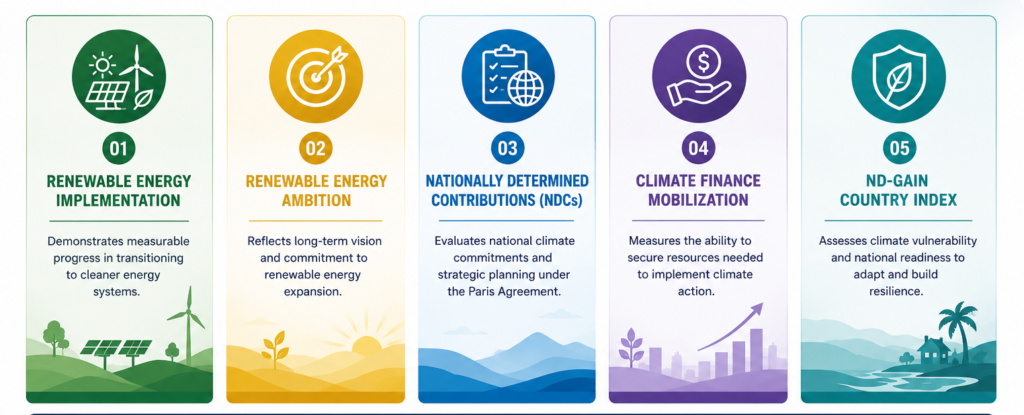
Renewable Energy Implementation
Implementation demonstrates whether climate ambitions are being translated into tangible results. Expanding renewable energy capacity reflects investments in cleaner energy systems, reduced dependence on imported fossil fuels, strengthened energy security, measurable progress towards decarbonisation. By evaluating implementation, the framework recognizes countries that are delivering real-world outcomes rather than relying solely on policy commitments.
Renewable Energy Ambition
Ambition reflects a country’s long-term vision. Renewable energy ambition considers the goals and commitments that governments establish for transforming their energy systems. Ambitious targets provide confidence to investors, guide national planning, and signal a commitment to accelerating the transition toward sustainable energy.
Nationally Determined Contributions (NDCs)
Nationally Determined Contributions (NDCs) represent each country’s formal commitments under the Paris Agreement. They establish national priorities for reducing greenhouse gas emissions, strengthening resilience, and adapting to climate change. Including NDCs within the assessment recognizes the importance of strategic planning and demonstrates whether countries have established a clear roadmap for climate action.
Climate Finance Mobilization
Climate finance mobilization measures a country’s ability to secure and leverage the financial resources needed to implement mitigation and adaptation initiatives. This indicator reflects more than funding alone. It also demonstrates institutional capacity, project readiness and the ability to translate climate priorities into investable opportunities.
ND-GAIN Country Index
Climate leadership is not measured solely by reducing emissions. It also requires the capacity to prepare for and respond to climate impacts. The ND-GAIN Country Index provides an internationally recognized measure of both climate vulnerability and national readiness, capturing factors such as governance, infrastructure, economic resilience, and adaptive capacity. Including this indicator ensures that the assessment recognizes countries that are not only pursuing mitigation but are also strengthening their resilience to future climate risks.
Together, these indicators provide a balanced picture of climate leadership by recognizing countries that demonstrate consistent progress across planning, implementation, investment, and resilience.
Why Barbados Won
Barbados stood out for its strong performance across five key indicators used to assess climate-smart development:
- Renewable Energy Implementation: 95.77% growth in renewable energy capacity since 2015—the highest among the countries assessed.
- Bold Ambition: A national commitment to achieving 100% renewable energy by 2035.
- Paris Agreement Commitments: Up-to-date Nationally Determined Contributions (NDCs) under the Paris Agreement.
- Mobilising Climate Finance– US$252.85 million in climate finance mobilised. More than 14 times the Caribbean regional average.
- Establishing Resilience: An ND-GAIN Score of 61, the highest among the countries assessed, reflecting strong climate resilience and readiness.
The indicators were assessed using data from independent regional and international sources that have been integrated into the Climate Smart Map. By bringing these datasets together into a single platform, the Map provides governments, investors and development partners with a clearer picture of climate ambition, investment opportunities and progress across the Caribbean.
Leadership Beyond the Numbers
While the assessment was based on five measurable indicators, climate leadership extends beyond what can currently be measured consistently across the region. Some aspects of climate leadership, particularly regional and global advocacy, remain difficult to assess consistently across all Caribbean countries.
Over the past decade, Barbados has become one of the Caribbean’s strongest voices on climate action, championing the interests of Small Island Developing States (SIDS) and advocating for reforms to the global financial system that would improve access to climate finance for vulnerable nations. Through the Bridgetown Initiative, the country has helped shape international conversations on debt reform, resilience financing, and equitable climate investment.
Why It Matters
The Climate-Smart Country of the Year Award is about more than recognising achievement. It demonstrates the value of measuring progress through credible data and measurable outcomes.
For governments, the framework provides a way to benchmark progress and identify opportunities for improvement. For investors and development partners, it offers greater confidence that climate action is backed by evidence and implementation.
As the Caribbean works toward becoming the world’s first Climate-Smart Zone, recognising measurable progress helps strengthen collaboration, attract investment and accelerate solutions that benefit the entire region.
Congratulations to Barbados on this well-deserved recognition!